
Special-needs students in Clark County faced missed pickups and late buses during the first week of school as CCSD rolled out new routing software and bell schedules, leaving some families scrambling for alternatives.
Families across Clark County experienced significant disruptions to special-needs student transportation during the first week of the new school year, as the Clark County School District (CCSD) implemented new bus routing software and adjusted bell schedules. The changes, intended to improve efficiency and accommodate later high school start times, instead left some students waiting for buses that never arrived or arrived late, forcing parents to find last-minute solutions.
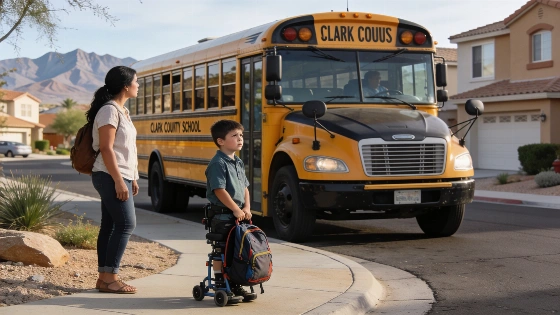
Christina Ross, a Henderson parent, reported that her son Kaleb, who attends Wolff Elementary School and requires daily curb-to-curb service due to Down syndrome, was not picked up for the first three days of school. Kaleb’s individualized education plan mandates a bus aide, but the absence of an aide led to his stop being skipped without prior notification. Ross only learned of the issue through the school principal, highlighting communication gaps during the transition.
New Software and Bell Schedules Create Challenges
CCSD acknowledged that the rollout of new routing and scheduling software, combined with the introduction of later high school start times, contributed to the delays and missed pickups. According to district data, on-time performance improved from 86% on Monday to 90% by Wednesday, but that still left hundreds of students affected. The district described the transition as complex, noting that it operates the largest district-run school bus fleet in the nation.
Felicia Gonzales, CCSD’s deputy superintendent of business and operations, stated that the district is working to improve reliability and aims to reach consistent, on-time service for all students. She added that route consolidation will continue throughout the year, but emphasized that service levels for students should not be impacted.
Families Face Difficult Choices
For many families, the disruptions meant rearranging work schedules or driving children to school themselves. Emily Marshall, whose 4-year-old son Hunter attends prekindergarten at Mathis Elementary School in the southwest valley, said his bus failed to arrive three out of the first four days. When it did arrive, it was over an hour late. Hunter, who has autism, relies on routine and the independence of riding the bus, making the missed pickups especially difficult for him.
Marshall noted that her nephews, who do not have special needs and live in the same neighborhood, also experienced late pickups. The family lives about two miles from the school—too far for young children to walk—so parents had to step in when buses failed to show. Both Ross and Marshall pointed out that not all families have the flexibility to adjust their schedules, and many have multiple children needing transportation.
District Response and Next Steps
CCSD apologized for the disruptions and encouraged families experiencing ongoing issues to contact the transportation department. The district said it expects further improvements as the new systems are refined and additional staff are hired. However, parents remain concerned about the impact on their children’s education and well-being, especially for those who depend on specialized transportation and support.
As the school year continues, CCSD will monitor performance and make adjustments to ensure that all students, particularly those with special needs, receive the reliable service they are entitled to under their education plans.