
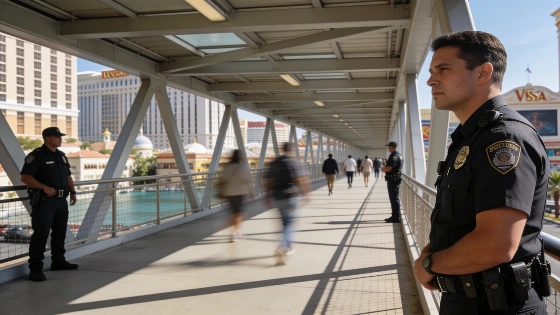
A federal court has cleared Clark County’s rule against stopping or standing on Las Vegas Strip pedestrian bridges, reshaping how crowds and performers move through the city’s busiest crossings.
Tourists and street performers now face misdemeanor charges for pausing on the Strip’s pedestrian bridges. The latest federal court ruling locks in Clark County’s ban, shifting the ground rules for anyone hoping to linger above Las Vegas Boulevard.
U.S. District Judge Jennifer Dorsey sided with the county on September 25, granting summary judgment and upholding the so-called “Strip Selfie Ban.” Months of legal sparring and heated public debate led up to this decision. The court dismissed arguments that the ordinance was vague, too broad, or a threat to free speech. According to KTNV and FOX5 Vegas, the judge left the county’s rule untouched.
The court classified the ban as a content-neutral safety regulation, applying not only to photography and performances but also to activities like sleeping, loitering, and vending if they cause people to stop on the bridges.
The county’s ordinance, passed unanimously on January 2, 2024, bars anyone from stopping or standing on Strip pedestrian bridges or within 20 feet of their stairs, escalators, or elevators. Only those waiting to use an escalator or elevator get a pass. Violators risk up to six months in jail or a $1,000 fine.
Clark County set up “pedestrian flow zones” to keep crowds moving. These bridges make up about 5.7% of the Strip’s sidewalk network. The county pointed to a decade of pedestrian studies showing unpredictable crowd surges and the need for clear rules to avoid bottlenecks. Judge Dorsey called the ordinance a narrow fix for public safety and crowd movement. She found it does not place a heavy burden on protected activity within its stated purpose, as KTNV reported.
The ACLU of Nevada challenged the law in February 2024, representing Lisa McAllister, who uses a manual wheelchair, and Brandon Summers, a violinist who plays on the Strip. Their lawsuit claimed the rule is vague and overreaching, criminalizing routine stops and squeezing out free expression. Plaintiffs argued that street musicians can’t simply move mid-performance, especially when using amplifiers or collecting tips. The ban, they said, hits both everyday walkers and working performers.
Judge Dorsey recognized the rule’s limits but saw it as a safety measure, not a speech crackdown. She noted the county could have written a tighter rule, maybe targeting certain times or bridges, but said the Strip’s unpredictable crowds justified a broader approach. The court found the ordinance strikes a workable balance between safety and access.
After Judge Dorsey's September 25, 2026 decision, the ACLU of Nevada filed an appeal with the U.S. Court of Appeals for the Ninth Circuit. As of early October, the ban remained in effect, and the case continued to draw attention from both civil liberties advocates and local officials.
For visitors, the ruling means stopping for a photo or to watch the view from a bridge could now bring a citation. Street performers and activists lose a key spot to reach crowds. Athar Haseebullah, executive director of the ACLU of Nevada, called the criminalization of even brief stops—including for wheelchair users—reckless. He confirmed the group will keep fighting the case in court, as KTNV reported.
Clark County officials welcomed the decision, saying the rule protects safety in the resort corridor while respecting public rights. The county points out that bridges are a small slice of the Strip’s pedestrian routes, and insists the rule is needed to keep crowds moving during busy times.
The legal fight continues as the ACLU of Nevada appeals. For now, the ban stands, and both visitors and performers face a new enforcement reality on the Strip’s bridges. The court’s decision leaves public safety as the top priority in these high-traffic zones.