

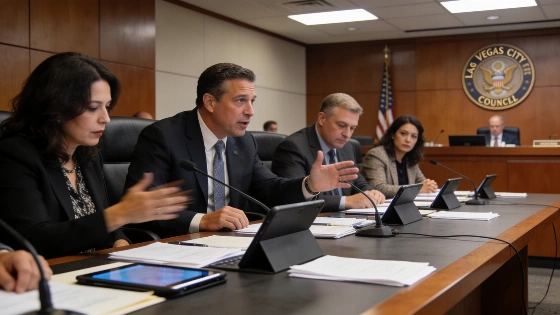
A decade-old pact between Las Vegas and Clark County on northwest infrastructure is set to expire in December, igniting disputes over who pays for public services and raising the stakes for land annexation and local taxes
Tempers are flaring in the northwest valley. The clock is ticking. Las Vegas and Clark County are at odds as a key service agreement nears its December expiration. Both sides are digging in over who pays for parks, sewers, and fire protection. The threat of forced annexation hangs over the talks.
This fight centers on a deal that splits up responsibility for public services in a part of the valley where city and county lines blur. City councilmembers Francis Allen-Palenske and Nancy Brune say Las Vegas taxpayers are footing the bill for county residents who use city services but don’t pay city taxes. County officials reject that claim. They call the city’s push to rewrite the deal a “money grab” and insist the county already pays more than its share.
In recent land use cases, the interlocal agreement has required both city and county approval for proposed projects in northwest Las Vegas, demonstrating its ongoing influence on development decisions.
What the expiring agreement covers
The current interlocal agreement is up for a five-year renewal unless both sides hammer out a new deal. It was meant to end years of fights over annexation and who delivers what services. The 12-page pact spells out how the city and county split up land use, parks, trails, sewers, fire protection, transportation, and flood control. It also blocks the city from annexing county land unless property owners ask for it. The county, in turn, can’t pass laws to limit city annexation rights.
Now, with the deadline looming, city leaders say the deal no longer works for their residents. At a recent city council meeting, Allen-Palenske said, “We are left holding the monetary bag.” She pointed to city fire and sewer services used by county residents in “county islands”—unincorporated pockets surrounded by city land. Las Vegas Fire & Rescue Chief Fernando Gray and community development director Seth Floyd both showed evidence that county residents benefit from city services without paying city taxes.
County pushback and accusations
Clark County commissioners Marilyn Kirkpatrick and April Becker fired back. They called the city’s claims “wrong and one-sided” and labeled the renegotiation a “money grab, plain and simple.” Commissioner Tom Collins, who’s seen past annexation fights, said the city council doesn’t know the history. He argued the county pays more than the city admits.
According to FOX5 Vegas, the interlocal agreement not only addresses cost-sharing for public services but also serves as a legal constraint on zoning changes and development projects that cross city-county boundaries. In one recent case, a county division recommended denying a development application because the requested zoning change was found to contradict the terms of the agreement, highlighting its practical impact on land use decisions.
This isn’t a new fight. State law changed in 2001, making it easier for cities to annex unincorporated land. Las Vegas tried to expand fast. That led to the first interlocal agreement in 2002. The current version, signed in 2016, was supposed to settle who pays for what. But the city grew by 7 square miles that year, and tensions never really faded. In 2018, Las Vegas tried to annex more county land. More than a thousand residents sent protest letters.
Annexation fears and tax implications
For northwest residents, this is personal. Many live in Rural Neighborhood Preservation areas. They want low-density zoning. Annexation could bring higher taxes and more development. Real estate valuation expert Terrence Farr says city and county property taxes are calculated differently. City residents usually pay more for the same property value. For example, county resident Gail Powers pays a 2.7 tax rate on her 4-acre property. Her neighbor across the street in the city pays a 3.2 rate. Powers, whose family has owned the land since the 1950s, says she’ll fight any forced annexation.
If the agreement lapses, Las Vegas could annex county land by city council vote. Property owners would have just 15 days to object, as Nevada law allows. The current deal requires property owners to request annexation. That protection would disappear if the pact ends.
What happens next
Both governments are gearing up for key meetings. Clark County meets October 6. Las Vegas meets October 7. City spokesperson Jace Radke and Commissioner Kirkpatrick say more details will come out then. The outcome could change who pays for northwest valley services. It could also redraw the political map for years.
These fights aren’t new in Southern Nevada. As reported earlier by Vegas Report, land use and development disputes have shaped the region’s growth for decades. Each side wants to protect its tax base and its say over future expansion.
The deadline for the interlocal agreement is more than a bureaucratic date. It’s a test. Can Las Vegas and Clark County find common ground? Or will the northwest valley become the next battleground in a long-running turf war? One thing is clear. If there’s no new deal, northwest residents face real uncertainty over taxes, services, and the future of their neighborhoods. This is more than paperwork. It’s a fight over who pays, who decides, and who shapes the fastest-changing part of Las Vegas.