
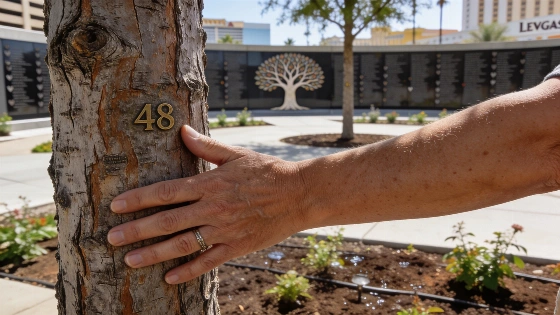
Nearly nine years after the Route 91 Harvest Festival shooting, the Las Vegas Community Healing Garden is still a place where people remember, reflect, and care for the memory of each victim. Fifty-eight trees stand for the lives lost, and the community keeps their stories alive.
In downtown Las Vegas, the Community Healing Garden is a rare place where a city’s grief has grown into something living. Almost nine years after the Route 91 Harvest Festival shooting took 58 lives, the garden is still cared for by people who want to keep each victim’s story close. FOX5 Vegas recently reported that the garden is still called a space for "remembrance" and is visited and maintained as of late September 2026. Its role in the community has not faded.
Visitors stop to read the biographies and messages on tiles for those lost on October 1, 2017. The garden’s design came from Jay Pleggenkuhle and Daniel Perez of Stonerose Landscapes. They sketched the idea on a napkin the day after the attack. Pleggenkuhle was moved by the pain of a local mother whose daughter had been at the concert. He saw how the tragedy reached every part of Las Vegas. Local news still calls the Route 91 shooting the 1 October tragedy, and the memorial is always tied to those victims, as reported by local outlets.
How the garden took shape
The City of Las Vegas and hundreds of volunteers helped build the garden in just four days. It opened to the public on October 6, 2017. The garden has a remembrance wall, a water wall, and a central Tree of Life. The most powerful part is the 58 trees, each one for a life lost in the Route 91 shooting. Pleggenkuhle says the garden "honors the lives of those lost on October 1" and also celebrates life, fitness, love, and compassion. The living plants are a sign of resilience and remembrance. FOX5 Vegas reports that Pleggenkuhle sees the memorial as proof of "the community’s capacity for unity and compassion" after tragedy.
From the start, the garden was meant to be a place for people to gather and grieve together. It gives people a space to share stories and comfort each other. Pleggenkuhle believes that without a place like this, people might pull away and face their pain alone.
Ongoing community involvement
The garden’s meaning has not faded. People from all over southern Nevada still care for the grounds. They make sure the 58 victims are not forgotten and that families know their loved ones mattered. Visitors read the biographies and tributes, learning about the victims as parents, partners, and friends—not just names. The remembrance community in Las Vegas is still active in 2026. Annual events like the 1 October Memorial Blood Drive, supported by the Vegas Golden Knights Foundation and Vitalant, continue, as reported by 8 News Now.
This commitment to remembrance matches the city’s wider efforts to honor those affected by tragedy. Other local projects, as reported earlier by Vegas Report, show Las Vegas bringing people together through shared spaces and events. Local government still directs Route 91 attendees and victims to state victim-assistance resources. The Las Vegas Review-Journal notes that the tragedy still shapes civic and administrative work in the city.
Extending the mission beyond Las Vegas
Pleggenkuhle’s work has reached beyond Las Vegas. Inspired by the Healing Garden, he now helps design and build similar spaces in other cities. The model—quick community action, thoughtful design, and ongoing local care—has become a guide for how other places can respond to shared trauma.
The Healing Garden’s continued presence shows the power of local action and the need for real places to remember. In a city known for change, this garden is different. Here, memory is rooted and cared for. Residents keep the stories of the 58 alive, making the garden part of Las Vegas’s daily life. Their care offers a model of compassion and resilience that reaches far beyond Nevada.