
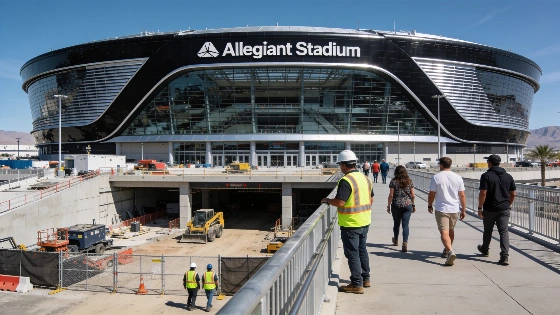
Allegiant Stadium will undergo a $158 million upgrade with $75 million in public funds to improve north-side access and add new decks before the 2029 Super Bowl. Construction is set to begin after the Raiders’ season ends.
Las Vegas is doubling down on Allegiant Stadium’s future, approving $75 million in public funds to overhaul the north entrance and expand fan amenities at the six-year-old venue. The move comes as the stadium faces mounting competition from new arenas nationwide and prepares to host the 2029 Super Bowl.
The Las Vegas Stadium Authority’s decision unlocks a $158 million project aimed at easing congestion for fans entering from the Strip and enhancing the overall event experience. The Las Vegas Raiders will cover the remaining $83 million, shifting the majority of cost-sharing to the team for the first time since the stadium’s 2020 debut.
What the Upgrade Will Change
The planned improvements focus on the north side, where pedestrian traffic has routinely bottlenecked during Raiders games and major events. The project will add new pedestrian and event decks, a plaza, and transportation enhancements, creating a more direct elevated walkway from the Strip. Many fans currently cross a bridge to reach the stadium, but the new design aims to streamline that journey and relieve pressure on existing infrastructure.
Construction is scheduled to begin after the Raiders’ season concludes, with completion targeted for late 2028 or before the 2029 Super Bowl. The stadium, which opened in 2020 at a cost of $2 billion, was originally built with $750 million in public funding. The new $75 million allocation will come from surplus room tax revenue, not from general funds or new taxes.
Why the Investment Matters Now
Allegiant Stadium has quickly become a cornerstone of Las Vegas tourism, hosting not only Raiders and UNLV football games but also concerts, championship events, and the 2024 Super Bowl. The venue is set to host the college football national championship this season and the NCAA Final Four in 2028. With five new stadiums opening or planned in cities like Buffalo, Chicago, Denver, Washington, D.C., and Nashville, Las Vegas faces a new era of competition for marquee events.
Steve Hill, president and CEO of the Las Vegas Convention and Visitors Authority, emphasized that keeping Allegiant Stadium at the top of its game is both a legal requirement and an economic necessity. “It is driving tourism right now more than ever at a time we need to drive tourism,” Hill said during the authority’s meeting. He also noted that the extra room tax revenue cannot legally be used to pay down stadium bonds, making reinvestment the only viable option.
Who Pays and Who Benefits
The Raiders will now assume responsibility for maintaining the new infrastructure, a shift that protects the public’s original $750 million investment. Raiders President Sandra Douglass Morgan, who previously highlighted the north entrance as a critical pressure point, attended the meeting but did not address the board this time. The upgrades are designed to benefit not just football fans but also concertgoers and visitors attending a growing slate of high-profile events.
Allegiant Stadium’s rapid evolution mirrors the broader transformation of Las Vegas as a sports and entertainment capital. As seen in reported earlier, the city’s venues are constantly adapting to maintain their edge in a fiercely competitive market.
Editorial Perspective
Las Vegas is not waiting for Allegiant Stadium to show its age before acting. By investing now—while the venue is still new by industry standards—the city is signaling that it intends to remain a top-tier destination for the world’s biggest events. The decision to use surplus room tax revenue, rather than new taxes or general funds, is a calculated move that shields residents while leveraging the visitor economy. With the Raiders taking on a larger share of costs and maintenance, the public’s stake is better protected than in the original deal. This upgrade is less about fixing what’s broken and more about staying ahead of the curve as other cities chase the same events. In a city built on spectacle and scale, Allegiant Stadium’s next act is already in motion—and Las Vegas is making sure it stays center stage.