
The Las Vegas Strip stretches 4.2 miles through Paradise and Winchester, transforming a former desert highway into a dense lineup of mega-resorts, casinos and entertainment venues that define the city’s visitor experience
What looks like the heart of Las Vegas is, in reality, a 4.2-mile stretch of South Las Vegas Boulevard that sits almost entirely outside the city’s official boundaries. The Las Vegas Strip, running from Sahara Avenue to Russell Road, has become a self-contained resort corridor—one that redefined the city’s global image without ever being part of the city proper.
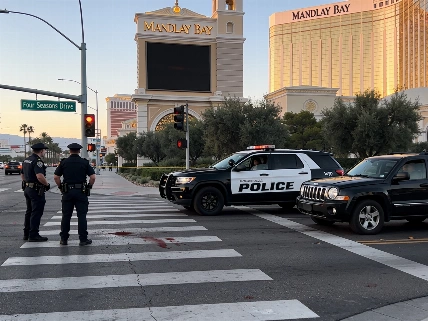
Visitors arriving for the first time are often surprised to learn that the Strip’s most famous resorts, from Mandalay Bay to The STRAT, actually stand in the unincorporated townships of Paradise and Winchester. This jurisdictional quirk is more than a technicality: it has shaped everything from resort development to local governance, and it continues to influence how the Strip operates today.
From Desert Highway to Entertainment Spine
The Strip’s origins trace back to the old Los Angeles Highway, later known as Highway 91, which once cut through open desert south of downtown Las Vegas. In 1941, El Rancho Vegas opened as the first major casino hotel along this route, setting off a wave of roadside resort construction that would soon eclipse the city’s original downtown gaming district. The Flamingo, launched in 1946 and linked to Benjamin “Bugsy” Siegel, brought a new level of glamour and entertainment focus, accelerating the transformation of the highway into a destination in its own right.
By the 1950s, the corridor had become a magnet for ambitious resort projects, each taking advantage of the wide road and available land to build ever-larger properties. Over time, the Strip’s development pushed further south, with older motels and small casinos giving way to the mega-resorts that now dominate the skyline.
The Rise of Mega-Resorts and Themed Frontages
The modern era of the Strip began in 1989 with the opening of The Mirage, which introduced the integrated mega-resort model: thousands of hotel rooms, expansive gaming floors, and headline attractions all under one roof. This template quickly spread, with properties like Bellagio, MGM Grand, and Mandalay Bay adding themed facades, water features, and massive entertainment venues that face directly onto Las Vegas Boulevard.
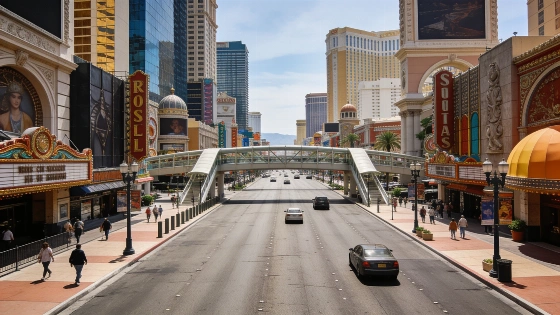
Today, the Strip is recognized as both an All-American Road and a Nevada Scenic Byway, not for its traffic but for the sheer density of entertainment structures lining its length. Walking the corridor means navigating broad sidewalks, pedestrian bridges over major intersections, and a relentless sequence of hotel towers and casino podiums. The visual impact is immediate: a continuous band of spectacle, engineered for maximum visitor engagement.
Geography, Access and Visitor Logistics
Despite its fame, the Strip’s geography remains rooted in the Las Vegas Valley’s flat desert basin, framed by distant mountains and long sightlines. Most of the corridor lies within Paradise, with sections in Winchester, and only a sliver touches the formal city limits. The boulevard itself is a multi-lane artery, with service roads and driveways feeding into the forecourts of each resort.
Pedestrian movement is shaped by the built environment: wide pavements, frequent stairways and escalators, and elevated walkways that cross over Tropicana Avenue, Flamingo Road, and other major junctions. For travelers, this means that walking between properties can involve significant distances and changes in elevation, especially during peak event weekends or convention periods.
What International Visitors Should Know
For travelers from Western Europe and beyond, the Strip’s layout and jurisdictional status have practical consequences. The official language is English, the currency is the US dollar, and entry requirements depend on nationality—UK and Irish travelers should consult their respective government travel advisories. The corridor’s design prioritizes spectacle and scale, so visitors should expect long walks, busy intersections, and a landscape engineered for both automotive and pedestrian access.
Major resort investments continue to reshape the Strip’s skyline and visitor experience. As reported earlier, large-scale projects and new venues are driving further development, reinforcing the Strip’s role as the city’s economic and entertainment engine.
The Las Vegas Strip is not just a collection of casinos—it is a deliberately constructed entertainment corridor that operates outside the city’s formal boundaries, governed by Clark County and shaped by decades of calculated development. This man-made landscape, engineered from a desert highway into a global destination, remains the defining axis of Las Vegas hospitality and spectacle. The Strip’s evolution is a reminder that in Las Vegas, the boundary between city and resort is not just blurred—it is a feature, not a bug, of how the city reinvents itself for every new wave of visitors.