
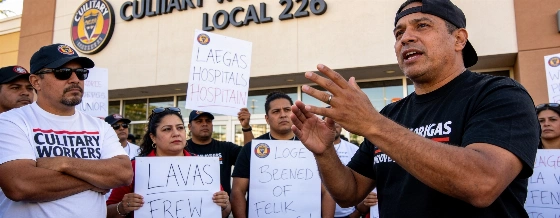
Hundreds of Culinary Workers Union Local 226 members have been protesting outside their Las Vegas headquarters since late August, demanding answers and pushing back against new health care rules that affect more than 60,000 hospitality workers.
One of Nevada’s most powerful unions is now facing anger from within. Since late August, groups of 100 to 200 Culinary Workers Union Local 226 members have gathered each week outside the union’s Las Vegas headquarters. They are protesting changes to health care coverage and how upcoming raises will be handled. On September 18, 2026, the protests grew. More than a dozen union members showed up at the headquarters, calling for an audit and a review of promised wage increases. Metro police and a tow truck were on site, according to KLAS 8 News Now, showing just how tense the situation has become.
The Fair Union Reform Movement 226 is behind the demonstrations. This is the most visible internal unrest the union has seen in years. Local 226 represents over 60,000 hotel and casino workers across Nevada and is a major player in the state’s hospitality industry and politics. By mid-September, The Nevada Independent reported that the protests had become a real internal fight. Republican candidate Cody Whipple said he would reach out to union leaders about the members' complaints.
Health plan changes spark backlash
The main issue is a new health care policy that started in September. Under the new plan, adult members can pick primary care doctors at one of the union’s four health centers. These centers offer dental, vision, physical therapy, and lab tests at no cost. Members can keep their outside primary care doctors, but those are now out-of-network and come with higher fees, as reported by The Nevada Independent. Union leaders say the new plan gives families free coverage, with no monthly premiums, copays, or deductibles for 60,000 members. The plan covers pediatrics, walk-in care, labs, radiology, chiropractic, acupuncture, and mental health support.
The four health centers now have more than 90 primary care providers. The newest center, nearly 99,000 square feet, opened in August 2026, according to The Nevada Independent. Union Secretary-Treasurer Ted Pappageorge has called the plan the best health care available for union members. He stressed to KLAS 8 News Now that there are no monthly premiums, copays, or deductibles.
Some members say the changes limit their choices and disrupt ongoing care. Rodolfo Valle, who works at The Cosmopolitan of Las Vegas and is a former shop steward, said he felt manipulated and unable to make his own health decisions. Blanca Moreno, a cleaner at Caesars Palace who has had cancer treatment, worries the policy could force her to leave the doctor who manages her care. Charles Pierre, another worker, questioned if four clinics can really serve 60,000 members quickly enough.
Blanca Rugerio, who works at Resorts World Las Vegas, said she paid about $2,000 for an emergency room visit after waiting for a referral from her new primary care doctor. She also pointed out that shorter work shifts can make it harder to qualify for coverage. The Nevada Independent reports that workers usually need to average about 30 hours a week to keep their benefits. Those who fall short can pay the health fund at the employer rate to stay covered.
Raises and calls for transparency
The way the union is handling upcoming raises has also caused frustration. Most members are set to get a raise starting October 1, but the exact amount is still unclear. The increase comes from a $1.55 hourly boost in benefits, which also covers health care and pensions. Graphics shared among members suggest that $1.06 of the $1.55 could go to the health and welfare fund, but union officials say that number is outdated and only a worst-case scenario.
The raise structure is tied to five-year contracts that Culinary and Bartenders Local 165 negotiated with dozens of Las Vegas resort operators through 2023 and part of 2024. Union leaders say the first-year raises—10 percent—are the biggest in the union’s 89-year history. They expect the average worker, who used to make about $28 an hour including health and pension, to reach $37 an hour by the end of the contract. Secretary-Treasurer Ted Pappageorge admitted that a big part of this year’s increase will go toward health care costs. He told KLAS 8 News Now that most members have already received more than $5 per hour in raises since November 2023, with another major raise coming on October 1, 2026.
Protest organizers have collected over 2,000 petition signatures demanding financial transparency about health funds and how raises are distributed. Donna Kelly, who ran for union president and lost, said she was motivated by members unhappy with the current leadership. “The members should be first, and that’s where I believe myself that the union has lost their way,” Kelly told FOX5.
Union leaders push back
Union officials have brushed off the protests as the work of a small group. Pappageorge told The Nevada Independent that only a few hundred out of 60,000 members are involved. He described the movement as being led by unhappy members spreading misinformation. He said the organizers are part of the 15 percent who voted against the current administration in May and that he has not met with protest leaders.
In a statement to FOX5, Pappageorge said most members have received more than $5 an hour in raises since November 2023, with another increase set for October 1, 2026. Sebastian Espinoza, a Caesars Palace worker who was on the negotiating committee, said rising health care costs are partly due to Medicaid cuts by the Trump administration.
What’s next for Las Vegas hospitality
The protests have exposed a rare public split inside a union that has long been a key part of Las Vegas hospitality. With more than 60,000 workers at major resorts and casinos, any ongoing conflict could affect the city’s visitor economy. The outcome will test whether the union can balance cost control, member benefits, and open leadership at a time when hospitality workers are still essential to Las Vegas. For now, union leaders face a tough job: rebuild trust among their own members or risk deeper divisions that could hit both workers and the wider industry.