

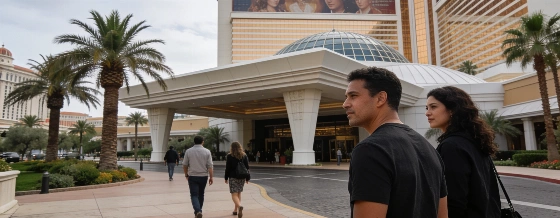
Las Vegas Sands shares have dropped more than 36 percent this year as investors question whether the company’s free cash flow can support its current valuation. Discounted Cash Flow analysis suggests a slight upside, but market caution persists.
Las Vegas Sands has seen its share price fall 36.7 percent since the start of the year, raising questions about whether its cash flow justifies the current market value. The drop has made investors more skeptical about the company’s ability to deliver reliable returns from its resort properties. In the second quarter of 2026, Las Vegas Sands reported revenue of about $3.15 billion and earnings per share of $0.59, both below analyst expectations. This shortfall has kept pressure on the stock and weighed on short-term sentiment, as noted in a MarketBeat company update.
The main issue is whether Las Vegas Sands can turn visitor demand at its resorts into steady free cash flow. Over the past year, the company generated about $2.24 billion in free cash flow, and analysts expect gradual growth as its properties mature. A Discounted Cash Flow (DCF) model, using a two-stage Free Cash Flow to Equity approach, currently values the company just above its recent share price of $41.27.
DCF Model Suggests Limited Upside
The DCF analysis shows that the market is more cautious about Las Vegas Sands’ future cash generation than the model itself. While the DCF value is slightly higher than the current share price, it assumes the company will keep producing multi-billion dollar annual free cash flows, with only modest growth as its resorts reach full capacity. In the second quarter of 2026, Marina Bay Sands in Singapore reported EBITDA of $689 million, and Macau operations added $430 million. Management pointed out that Macau’s results were affected by a low VIP rolling hold of 1.35%, according to the Fortune Q2 2026 earnings call transcript.
Investor discussions on Simply Wall St show a range of views on the stock’s value. Some argue that Las Vegas Sands could be undervalued by up to 30 percent, pointing to the full opening and ramp-up of The Londoner in Macao as a possible driver for higher revenue and cash flow. Still, these forecasts depend on how the company’s resorts actually perform and on management’s investment decisions. Company profiles continue to highlight The Londoner Macao, along with Venetian Macao, Parisian Macao, and Four Seasons Hotel Macao, reflecting a focus on Macau operations.
Market Skepticism and Management Choices
Valuation models only go so far. The outcome for shareholders will depend on how well Las Vegas Sands’ management handles investment, risk, and the timing of returns. The company’s ability to maintain and grow free cash flow will be tested by operational challenges and shifting market expectations. Despite the weak share price, Las Vegas Sands bought back $787 million of its own shares and paid a regular quarterly dividend of $0.30 per share in the same quarter, continuing to return capital to shareholders even as skepticism lingers.
The company’s situation is similar to what’s happening in other sectors, such as retail, where brands like Skims have expanded in Las Vegas, as reported earlier. In both cases, investor sentiment depends on the outlook for future cash flows and confidence in management’s growth plans. By mid-September 2026, Las Vegas Sands stock had hit a new one-year low, and broker consensus stayed at Hold, showing that doubts about valuation and recovery remain.
What Investors Should Watch
Las Vegas Sands’ current share price shows that the market is not fully convinced by the company’s projected cash flow growth. The DCF model points to a slight upside, but not enough to erase concerns about future performance. The ramp-up of The Londoner in Macao could help, but the real test is whether management can deliver steady cash flow in a competitive hospitality market. Investors should focus on the company’s operational results and the actual performance of its resorts, rather than relying only on valuation models or optimistic forecasts. As of the end of the second quarter, independent market reviews in September 2026 noted that Las Vegas Sands had several billion dollars in liquidity, including cash and available credit lines, giving it some flexibility as it faces ongoing market uncertainty.