
Lutheran Social Services of Nevada has filed for bankruptcy after a failed $1.47 million building sale, suspending food and housing aid for Las Vegas residents and raising questions about the future of the Boulder Highway campus
The collapse of a $1.47 million building sale has pushed Lutheran Social Services of Nevada into bankruptcy, freezing operations at its Boulder Highway campus and leaving vulnerable Las Vegas residents without critical food and housing support. The nonprofit’s financial unraveling, triggered by a failed deal with Hope Christian Health Center, now places the fate of a major community resource in the hands of a court-appointed trustee.
For years, Lutheran Social Services of Nevada operated as a lifeline for seniors and low-income families, distributing hot meals, groceries, and housing assistance from its Boulder Highway facility. That lifeline snapped after the organization’s board filed for bankruptcy late Friday, following months of mounting debt, leadership turmoil, and a failed attempt to sell the property to another nonprofit.
Failed Sale and Mounting Debt
The planned sale to Hope Christian Health Center, a North Las Vegas-based nonprofit, was supposed to stabilize Lutheran Social Services’ finances. The deal, valued at the building’s appraised $1.47 million, fell apart when Hope Christian’s CEO, Steve Flores, cited “too many things tangled up in that purchase”—including unresolved debt, liens, and restrictions tied to government funding. “Too messy. Too ugly,” Flores said, explaining why his organization walked away from the deal despite plans to offer medical services and a food pantry at the site.
With the sale dead, Lutheran Social Services’ board—comprised of Henderson City Councilwoman Carrie Cox, attorney Jason Stoffel, and home inspector Shawn Davis—filed for bankruptcy, stating they had exhausted all other options after the mismanagement and termination of former CEO Tim Bedwell. The bankruptcy filing lists a range of creditors, including banks, vendors, and even Tim and Michele Bedwell themselves. The organization had previously used the building as collateral for a $750,000 line of credit from MidFirst Bank, which was fully drawn and left unpaid, according to the nonprofit’s former part-time CFO.
Leadership Crisis and Controversy
Financial instability at Lutheran Social Services accelerated in 2024, when board members and key staff resigned after learning of $8,500 monthly payments to then-CEO Tim Bedwell’s wife, Michele, and her business partner, Adam Kent. These payments continued even as the nonprofit struggled to meet payroll and pay vendors. The controversy deepened when the two Lutheran pastors on the board resigned in December 2025, citing the refusal of Bedwell, Kent, and Cox to step down amid the turmoil. The organization’s affiliation with the Lutheran Church had already become tenuous, with the church largely cutting ties as the crisis unfolded.
By October, Lutheran Social Services had suspended most operations, with only sporadic food and clothing distributions continuing. The board’s statement on the bankruptcy emphasized regret for the suspension of services and acknowledged the hardship for community members in need.
Millions in Public Funding at Stake
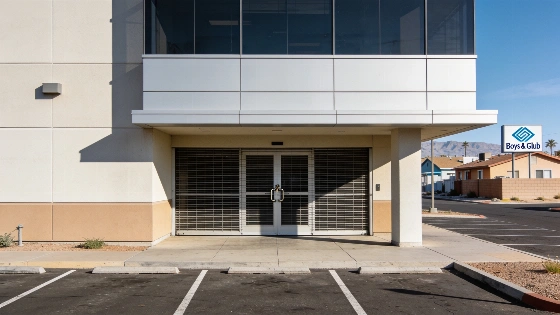
The Boulder Highway campus was built with substantial public investment. In 2016, Clark County approved $5.8 million in federal Community Development Block Grant funds for the campus, with about half allocated to the Lutheran Social Services building and the rest to a Boys & Girls Club. In 2023, the county awarded an additional $1.8 million in federal grants for a kitchen expansion. The use of government funds imposed restrictions on the building’s future use, complicating any potential sale and lowering its appraised value.
Clark County has demanded repayment of $39,375 in advanced payments for services not provided, and is now assessing next steps as the bankruptcy process unfolds. The court-appointed Chapter 7 trustee, Troy Fox, will take control of the organization’s remaining assets and oversee creditor claims.
Impact on the Community
The immediate effect of the bankruptcy is the suspension of food, housing, and senior meal programs that served hundreds of Las Vegas residents. Hope Christian Health Center, which had hoped to expand its services into the Boulder Highway campus, is now considering parking a mobile unit in the lot to maintain some presence in the neighborhood. “Once again, it’s the community that is losing out,” Flores said, pointing out that public money originally funded the facility.
For Las Vegas, the unraveling of Lutheran Social Services is a cautionary tale about the fragility of nonprofit operations dependent on public funding and the consequences of internal mismanagement. The organization’s collapse leaves a gap in services for some of the city’s most vulnerable residents, while the fate of a publicly funded campus remains uncertain. The board’s insistence that every option was exhausted rings hollow against the backdrop of years of controversy and failed oversight. In the end, it is the community—who paid for the building and relied on its services—that bears the cost of this organizational failure.