
The Roxy hosts a double feature exploring Las Vegas’s architectural evolution with the new film Learning from Learning from Las Vegas and a 35mm screening of Viva Las Vegas on September 12 and 19
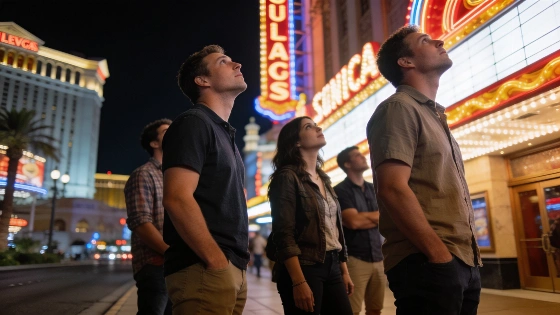
The Las Vegas Strip is more than just a backdrop for entertainment. It’s a record of American ambition, reinvention, and spectacle. This week, the Roxy puts that history in focus with a double feature: the new experimental documentary Learning from Learning from Las Vegas and a 35mm screening of the 1964 film Viva Las Vegas. Together, they offer a look at how the city’s architecture and pop culture have shaped each other over the years.
Directed by Sam Taffel and Gillian Waldo, Learning from Learning from Las Vegas revisits the city through Denise Scott Brown’s influential architectural study, Learning from Las Vegas. The 18-minute film, as described in the Roxy Cinema program, weaves together archival footage from Brown and Robert Venturi’s original research with new 16mm scenes shot in 2024. The result is a quick, sometimes playful, and often thoughtful look at how Las Vegas’s architecture keeps challenging and redefining American taste.
How Las Vegas Became an Architectural Laboratory
Las Vegas’s transformation started in the 1930s, when the Hoover Dam was built and gambling was legalized in 1931. These changes set off a period of rapid growth. By the 1940s, figures like Bugsy Siegel were reshaping the skyline, and the Strip became a destination for both high-rollers and everyday visitors. El Rancho Vegas, the first major casino-hotel on the Strip, opened in 1941. The Flamingo followed in 1946, speeding up the Strip’s shift into a center for resort tourism and entertainment.
Denise Scott Brown, who came to Las Vegas from South Africa, saw the city as a "non city" that didn’t fit academic expectations. Her work with Venturi and Steven Izenour led to Learning from Las Vegas in 1972, a book that forced architects to take seriously the city’s neon, commercial signage, and everyday urban life. The book’s influence is still felt, with Brown’s voice in the new film recalling her first reaction to the Strip: “Do I love it, do I hate it? Which is it? I’m not sure, but I’m very, very attracted.”
Pairing Film and City on the Big Screen
Taffel and Waldo’s process for making Learning from Learning from Las Vegas echoed the collaboration between Brown and Venturi. Both pairs met as colleagues at universities—Brown and Venturi at the University of Pennsylvania, Taffel and Waldo at the University of Wisconsin-Milwaukee—and both found inspiration in everyday places. Waldo points out that Brown’s outsider perspective brought a critical eye to American landscapes, finding value in what others overlooked.
Screening Viva Las Vegas alongside the documentary is intentional. George Sidney’s film, starring Elvis Presley, captures the Strip at its 1960s peak—a snapshot of the city as Brown and Venturi saw it. Presley’s character, Lucky Jackson, is a racecar driver with more grit than money, and his story fits the city’s reputation for risk and reinvention. The film’s musical numbers and on-location shots offer a rare look at the Strip’s midcentury architecture, with scenes that echo the photographs behind both the original book and the new documentary.
Las Vegas as a City of Constant Reinvention
Las Vegas is always changing. The skyline is in constant flux, with old hotels making way for new resorts in a cycle of demolition and rebuilding. This churn is part of the city’s identity, with building implosions drawing crowds and headlines. What was once dismissed as flashy or garish is now studied as a reflection of American culture’s shifting values.
The city’s willingness to change isn’t limited to its buildings. The Strip itself is a roughly 4.2-mile stretch along South Las Vegas Boulevard, most of it actually outside the official city limits and under Clark County’s jurisdiction. Even the housing market follows the same pattern of development and reinvention that shapes the city’s entertainment and hospitality industries.
What to Expect at the Roxy Screenings
The Roxy’s double feature is more than a trip down memory lane. Learning from Learning from Las Vegas offers a current look at the Strip’s evolution, while Viva Las Vegas captures the city at its pop-culture height. According to the Roxy Cinema schedule, screenings are set for September 12 and September 19, 2026. The September 19 screening is on 35mm, with directors Taffel and Waldo attending for a Q&A. For anyone interested in how Las Vegas’s architecture and entertainment intersect, this is a rare chance to see the city’s past and present in conversation on the big screen.
Las Vegas has never stood still. Its architecture, entertainment, and identity are all built on change. The Roxy’s programming this week invites audiences to see Las Vegas as a place where spectacle and substance are always in flux. In a city where fortunes can change overnight, that restless energy is part of what keeps Las Vegas unique.