
A shift from just-in-time to just-in-case inventory strategies is changing how companies select warehouse sites in Las Vegas, with increased demand for larger, more flexible industrial spaces and new infrastructure requirements.
Las Vegas is seeing a transformation in its industrial real estate market as companies across the region and beyond move away from just-in-time (JIT) inventory management and adopt just-in-case (JIC) strategies. This shift, highlighted at the recent “Navigating the Modern Supply Chain” panel hosted by CREDA’s Southern Nevada chapter at The Orleans, is driving new demand for warehouse space and changing the criteria for site selection in Southern Nevada.
According to Ruben Ramirez, head of occupier services for the Americas Industrial & Logistics division at CBRE, and John Kirkman, managing senior director and supply chain advisory leader at CBRE, the move toward JIC is a direct response to ongoing supply chain disruptions. Factors such as global trade volatility, pandemic-related shocks, port congestion, and inflation have made supply chain interruptions a baseline risk, not an exception. As a result, companies are now prioritizing inventory buffers and regional distribution hubs over the traditional focus on minimizing costs through port-proximate facilities.
Warehouse Demand Shifts Inland
Historically, JIT supply chains favored warehouses near ports and major import gateways, but the new JIC approach is pushing inventory closer to end consumers. Kirkman noted that midcontinent markets like Dallas, Columbus, and Kansas City are emerging as key distribution hubs, with companies moving from one or two large coastal centers to three or four regional hubs. In Las Vegas, this trend is reflected in a slowdown in port-proximate warehouse absorption, which has reached a 15-year low, while demand for larger, more flexible spaces is rising.
During the pandemic, the region saw a surge in industrial demand, with 500 million square feet added nationwide in 2021-22. Ramirez explained that this was driven not by e-commerce, but by companies building up safety stock to weather disruptions. The trend is returning as businesses again plan for uncertainty, leading to distribution centers increasing their square footage by 15 to 25 percent for the same throughput compared to JIT models.
New Criteria for Site Selection
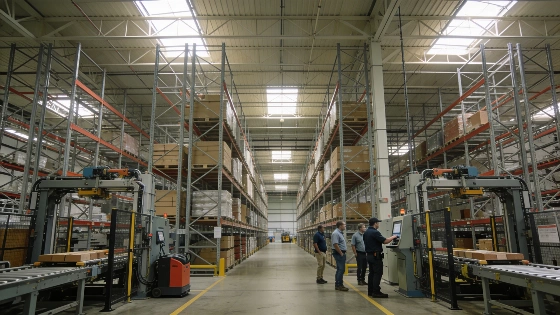
The shift to JIC is also changing what companies look for in industrial properties. Power availability has become a primary constraint, with demand for higher power density, 36-foot clear heights, and smart building infrastructure now standard. Retrofitting older properties to meet these requirements is often a major undertaking. Site selection now involves evaluating water access, term flexibility, and the ability to support automation, in addition to traditional factors like transportation infrastructure and labor availability.
Automation is playing a larger role, with companies closing traditional distribution centers in favor of new, highly automated facilities. This is changing workforce needs, as technical skills are now in higher demand than manual labor. Kirkman pointed out that while automation can reduce headcount, the technicians required to operate these systems command higher wages, and there is a shortage of skilled workers in the U.S. today.
Cost and Risk in the New Supply Chain
While JIC strategies offer greater protection against supply disruptions, they come with higher costs due to increased inventory holding. Most companies are finding a balance between JIT and JIC, but the center of gravity is shifting toward more robust inventory buffers. Kirkman emphasized that safety stock is now a critical variable, protecting revenue during disruption events and ensuring companies can continue operations even when supply chains are strained.
These changes are part of a broader evolution in Las Vegas commercial real estate, as the city adapts to new business realities. The region’s ability to meet these evolving requirements will shape its role as a logistics and distribution hub in the years ahead. For comparison, other sectors in Las Vegas have also adapted to changing market demands, such as the recent expansion of high-limit gaming spaces at Plaza Hotel & Casino, reflecting how local businesses are responding to shifting customer needs and operational challenges.