
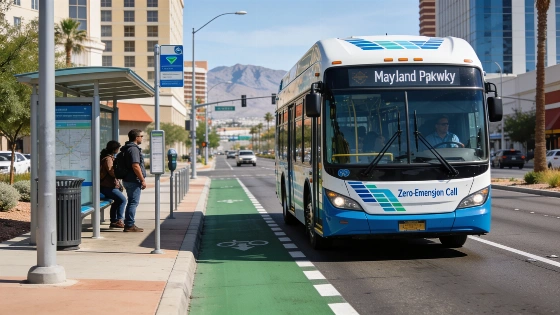
The new Maryland Parkway Bus Rapid Transit Red Line is now operating, reducing transit commute times by 20% along a corridor connecting downtown Las Vegas, UNLV, and Harry Reid International Airport
Las Vegas transit riders along Maryland Parkway are seeing faster commutes as the new Bus Rapid Transit (BRT) Red Line officially launches service, marking a major step in the $378 million corridor overhaul. According to a national case study by the Transportation Construction Coalition, federal and local investments in the project have already reduced transit commute times by 20% along the 12.5-mile route.
Maryland Parkway is a critical artery for Southern Nevada, supporting 109,000 jobs and home to 63,000 residents. The corridor connects downtown Las Vegas, the Las Vegas Medical District, Sunrise Hospital, UNLV, and Harry Reid International Airport, making it one of the region’s busiest transit routes outside Las Vegas Boulevard.
Red Line Launch Brings New Buses and Dedicated Lanes
The Red Line replaces the former Route 109, introducing a zero-emission hydrogen fuel cell bus fleet and dedicated transit lanes along a 7.3-mile stretch. Buses now run every 12 minutes during daytime hours, seven days a week, serving approximately 9,000 daily riders. The dedicated lanes are designed to bypass general traffic congestion, helping to minimize delays and improve reliability for transit users.
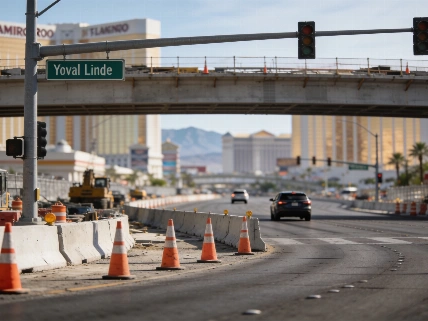
To accommodate the new rapid transit system, one general travel lane in each direction was removed along Maryland Parkway, reducing the roadway from three lanes to two plus a dedicated bus lane. This change affects a route traveled by about 35,000 vehicles daily. Not all segments of the corridor include dedicated bus lanes; in areas like the Medical District, space constraints prevent their installation, while on-street parking was removed in other sections to make room for the new route.
Construction Timeline and Ongoing Work
Construction on the Maryland Parkway BRT project began in August 2024, funded by a combination of the federal Infrastructure Investment and Jobs Act and local fuel revenue indexing. While the Red Line is now operational, active construction continues along portions of the alignment. About four miles between Sahara Avenue and Russell Road still require roadway and utility work due to ongoing coordination with adjacent projects and utility relocations. Despite the construction, access to businesses and transit stops remains open, according to the Regional Transportation Commission of Southern Nevada (RTC).
Impact on UNLV and Community Access
The project has already reshaped the area in front of UNLV’s main campus, where university leaders expect significant benefits for students and staff. The Red Line’s debut coincided with the start of UNLV’s fall semester, providing improved access as tens of thousands of students returned to campus. RTC officials have emphasized that Maryland Parkway is the agency’s most productive transit route outside Las Vegas Boulevard, making the investment critical for matching the corridor to community needs.
Why Bus Rapid Transit Was Chosen
The RTC board selected bus rapid transit for Maryland Parkway in 2019, opting for lower costs and greater operational flexibility compared to a previously proposed light rail system. The light rail plan, which would have placed tracks along the curb lanes, carried an estimated $1 billion price tag. While light rail remains a future option for other valley corridors, the current BRT approach allows the RTC to adjust routes and stops as transit demand evolves.
Federal Investment and Regional Growth
The Maryland Parkway project is highlighted by the Transportation Construction Coalition as an example of how sustained federal investment can help fast-growing metropolitan areas modernize aging transit infrastructure. The coalition, a partnership of 33 national associations and construction unions, notes that projects like this are essential for keeping pace with Southern Nevada’s rapid population growth and changing transportation needs.