
The Culinary Academy of Las Vegas has expanded its Westside campus, adding new hands-on training spaces and programs to help local residents and hospitality workers advance in the city’s hotel and restaurant industry.
The Culinary Academy of Las Vegas has completed a major expansion of its Westside campus, adding new facilities and programs designed to prepare local residents and hospitality workers for careers in Las Vegas’s hotel, restaurant, and service industries. The nonprofit training center, located in the Historic Westside, now offers a wider range of hands-on and classroom-based courses aimed at both young adults and current hospitality employees seeking to advance their skills.
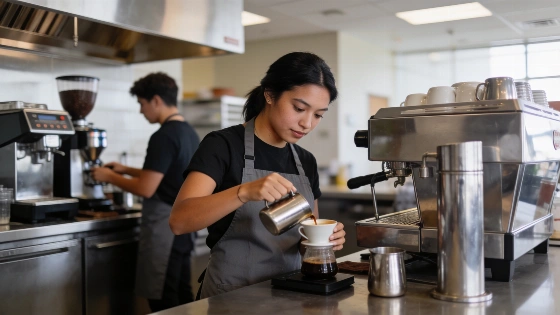
For recent high school graduate Yahirra Vásquez, the academy provided a clear path into the workforce. After finishing a three-week barista and beverage attendant program in August, Vásquez gained practical experience at the newly opened 710 Coffee Bar, a student-run café inside the academy. The program covers everything from coffee preparation to customer service, giving students real-world practice in a working environment.
Expanded Campus and Realistic Training Spaces
The academy’s recent expansion added 15,000 square feet to its campus, funded by a Clark County grant and state and federal New Markets Tax Credit support. According to executive director Bobbi Damrow, the project included a new barista classroom, upgraded equipment, and a “hotel hallway” featuring simulated guest rooms. These rooms, furnished by major Strip partners such as Resorts World, Caesars Palace, MGM Grand, Palms, and Golden Nugget, allow students to practice technical skills in realistic settings, from making beds to maintaining guest spaces.
The academy’s goal is to serve as a “simulation center” for the hospitality industry, offering students opportunities to learn in environments that closely mirror actual hotel and restaurant operations. In addition to the 710 Coffee Bar, students operate the West Side Bistro, serving meals to the community, and the 500 Grand Café inside the Clark County Government Center, where they practice quick-service skills. Culinary students also prepare meals for the North Las Vegas correctional center and the Sunrise Children’s Foundation, while banquet service training takes place in the academy’s renovated event center, now available for weddings, parties, and conferences.
Supporting Career Growth in Las Vegas Hospitality
Founded in 1993 as a training trust by local hospitality unions and Strip employers, the Culinary Academy was created to help current workers develop new skills and move up within the industry. Today, the academy partners with 52 hotel and resort properties across the Strip, downtown, and nearby areas, including Rio. Unionized employees at these properties can attend the academy as part of their benefits package, while other students pay tuition to enter the hospitality field.
Damrow notes that the academy’s continuous training model—new cohorts start every two weeks—helps meet the ongoing demand for skilled workers as Las Vegas’s hospitality sector grows and evolves. Courses range from two-week programs for entry-level positions to a 12-week professional cook track. The barista program, in particular, was developed in response to high demand for coffee professionals in the local job market.
Removing Barriers and Providing Support
The Culinary Academy works with Clark County Social Services to cover tuition for students whose income falls below Nevada’s living wage, aiming to remove barriers such as transportation, childcare, uniforms, and food insecurity. Support services are available for up to three months after graduation, helping students transition into employment. The academy also assists with job placement, sending graduates to hiring fairs and sharing opportunities with partner properties.
For Vásquez and her classmates, the combination of hands-on experience and classroom learning has been key. The academy emphasizes that mistakes are treated as learning opportunities, and students are encouraged to build confidence in real-world settings. While Vásquez is still seeking her first job after graduation, she says the academy is actively helping her and other graduates connect with employers, particularly those affiliated with the Culinary Union.
Las Vegas Industry Partners and Community Impact
According to Damrow, the academy’s collaborative approach—bringing together major resorts to invest in workforce development—sets it apart nationally. The model is designed to empower people in transition, support young adults not currently in school or work, and provide a steady pipeline of skilled workers for the city’s hospitality sector. As Las Vegas continues to grow and new projects come online, the Culinary Academy aims to ensure that local residents have access to the training and support needed to build lasting careers in the industry.