

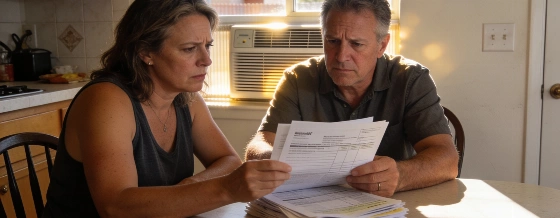
Moving to Las Vegas on Social Security and a pension looks affordable until hidden expenses like summer utility spikes and property tax resets hit in the first year. Here’s what new residents need to know before relocating
Retiring in Las Vegas on a fixed income can look easy—until the first summer electric bill arrives. Many newcomers find that the budget cushion they expected disappears once the desert heat sets in and the real cost of living shows up, well beyond what any online calculator suggests.
On paper, Nevada’s lack of state income tax and lower housing costs compared to coastal cities make Las Vegas seem like a retiree’s bargain. Social Security, pension checks, and IRA withdrawals aren’t taxed by the state, and the cost-of-living index sits just below the national average. The Tax Foundation ranks Nevada among the most tax-friendly states for retirees as of September 2026, with the state holding the 7th spot for individual income tax and 17th overall in the State Tax Competitiveness Index. But for new arrivals, the reality is shaped by expenses that rarely show up in pre-move research.
Hidden expenses after the move
The biggest shock for many is the summer cooling bill. A home that seemed affordable in March, based on a mild spring utility statement, can cost several times more to cool in July and August. The only way to get a real sense of this cost is to request the actual twelve-month billing history from NV Energy for the specific address. If the seller won’t provide it, that’s a red flag.
Property taxes in Clark County are another area where expectations often don’t match reality. Nevada law caps annual property tax increases for owner-occupied homes at 3%, but this only applies if you both own and live in the home as your primary residence. When a home changes hands, the new owner’s tax bill resets based on the current taxable value, not the previous owner’s lower, capped amount. For tax district 200, which covers Las Vegas and Summerlin, the combined rate is $3.2782 per $100 of assessed value for the 2026–2027 fiscal year. This helps explain why a new owner’s first tax bill can be much higher than the seller’s last bill, as detailed in the Clark County Assessor’s public guidance. Before closing, buyers should contact the county assessor for a written estimate of the post-transfer tax bill. Insurance premiums can also change sharply based on wildfire risk, hail exposure, and roof age, so binding quotes for the exact property are essential.
Water, healthcare, and transportation factors
Southern Nevada’s water authority enforces strict landscaping rules, including turf conversion requirements and fines for noncompliance. In 2026, SNWA restrictions on landscape plantings and a fall watering schedule—effective from September 1 through October 31 for Las Vegas, North Las Vegas, Henderson, Boulder City, and parts of Clark County—remain in effect. New residents should check the current regulations for their address before assuming the yard can stay as is. For new homes, there are extra rules: pools are limited to 600 square feet, and lawns are banned in new residential projects, so a home’s exterior may not match marketing photos. Healthcare access is another factor that’s easy to overlook. Las Vegas still lags behind national averages for physicians per capita, especially in specialties. Prospective residents relying on Medicare should check that both primary care and specialist providers are accepting new patients in their target ZIP code.
Las Vegas is a car-dependent city. When driving is no longer an option, costs for rideshare, delivery, and paid help can add up quickly—expenses that rarely appear in relocation calculators. The year a retiree gives up the car is often the year their budget faces new pressure.
Who can make it work
Retiring comfortably in Las Vegas depends on a specific financial setup: a paid-off or nearly paid-off home, combined Social Security and pension income that meets or exceeds the national average household expenditure of $78,535 after factoring in the tax advantage, and enough cash on hand to handle a summer utility spike and the first-year property tax reset. Only owner-occupants get the 3% property tax cap; non-owner-occupants don’t, which matters for retirees buying a home for the first time and planning their monthly budget. Healthcare relationships should be set up locally before the move. Those who simply average annual numbers and expect monthly cash flow to match are likely to be caught off guard by the city’s uneven expense pattern.
For those considering senior living options, the local market is still changing. As reported earlier, new investments in Summerlin’s senior communities show ongoing demand for alternatives to traditional homeownership, but the same careful review of costs and services applies.
Editorial perspective
Las Vegas can live up to its reputation as a tax-friendly, lower-cost retirement spot—but only for those who do their homework. The real test comes not in the first month, but in the first full year, when the true rhythm of bills, taxes, and healthcare access becomes clear. Retirees who thrive are the ones who demand hard numbers for every address, check local medical access, and keep a cash cushion for the city’s seasonal swings. In Las Vegas, the difference between a comfortable retirement and a budget crisis isn’t obvious on a spreadsheet. It shows up with the first summer’s electric bill and the property tax statement that follows.