

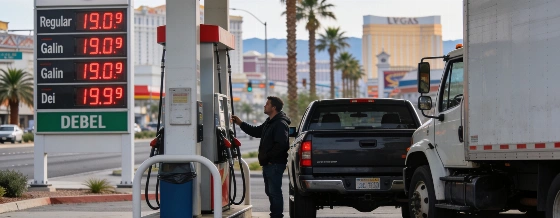
Diesel in Las Vegas has reached $6.67 per gallon, with gasoline prices close behind. The city’s heavy reliance on out-of-state refineries and pipelines leaves residents and businesses exposed to further price hikes.
Drivers and businesses in Las Vegas are facing a sharp jump in fuel costs, with diesel now at $6.67 per gallon and regular gasoline at $5.18, according to AAA. Diesel has reached a new record for the city, while regular gas is just 40 cents below its 2022 peak. AAA data reported by the Las Vegas Sun shows the average diesel price in Las Vegas hit $6.59 per gallon on September 18, 2026, breaking the previous state record of $6.05 set in 2022. Across Nevada, diesel averaged $6.65, with Reno seeing prices as high as $6.98.
Las Vegas is especially vulnerable to fuel supply problems. The city has no major local refineries and depends on two main pipelines: CALNEV from Southern California and UNEV from Utah. Most of the area’s gasoline, diesel, and jet fuel comes from California, so any trouble at those refineries quickly affects Southern Nevada.
Pipeline dependence puts Las Vegas at risk
Recent shutdowns at major California refineries have tightened fuel supplies on the West Coast. Phillips 66’s Los Angeles refinery and Valero’s Benicia facility, both key suppliers, have gone offline. With fewer refineries running, any new outage or pipeline problem—especially with CALNEV—could push Las Vegas prices up even faster than elsewhere.
Just a week ago, regular gas in Las Vegas averaged $5.01, and a month ago it was $4.77. Diesel has climbed even more quickly, up from $6.36 last week and $5.79 a month ago. These jumps aren’t just following national trends—they show how much the city depends on outside supply and how fragile its fuel logistics are. AAA reports diesel in Las Vegas rose from $6.31 to $6.59 per gallon in one week, a sharp spike rather than a slow climb. Local news noted that by September 15, diesel in the area had already reached $6.53, with the statewide average at $6.58, showing prices were rising even before the latest official numbers.
High diesel prices strain the local economy
While $5 gasoline gets attention, diesel near $7 is a bigger problem for the local economy. Las Vegas brings in almost everything by truck—food, building materials, retail goods, and casino supplies all depend on diesel. Reuters has reported that diesel above $6 is now common across the U.S., but the impact is worse in a city so reliant on trucking. AAA data shows the national average for diesel reached $6.23–$6.31 per gallon by mid-September 2026, so this is not just a Nevada issue.
When diesel stays expensive, higher transportation costs quickly show up in grocery bills, construction prices, and restaurant menus. The longer this lasts, the more these costs become part of daily life for residents and visitors. According to Fox 5 Vegas, diesel prices in Nevada have jumped 69% in a year, from $3.97 to $6.71 per gallon, putting extra pressure on local businesses and consumers.
Global oil disruptions drive local price spikes
Crude oil remains costly, with Brent at about $104 a barrel and West Texas Intermediate at $101. Prices have eased a bit from earlier highs, but the main problems haven’t gone away. The Saudi East-West Pipeline was damaged, some Saudi crude shipments to Europe were canceled, and tanker traffic through the Strait of Hormuz is still disrupted. Saudi Arabia’s efforts to reroute shipments haven’t fully stabilized the market.
These global issues feed directly into Las Vegas’s fuel market. If another Southern California refinery shuts down or a pipeline problem occurs, prices could jump even higher. The Nevada State Energy Security Plan notes that California refineries are the main source of transportation fuel for the region, making local prices sensitive to West Coast supply shocks. In September 2026, the Exxon Mobil Joliet refinery had an unplanned shutdown due to a power outage, as reported by Reuters. Power was restored the same evening, but the incident showed how easily the supply chain can be disrupted.
What’s next for Las Vegas drivers?
Fuel prices are hard to predict, but several outcomes are possible. If Saudi pipeline repairs go well and California avoids more refinery problems, regular gas could settle between $5.00 and $5.30 before dropping. If current conditions continue—with oil at $100–$110 and tight refining capacity—$5.30 to $5.60 is likely soon. A major new disruption could push prices to $5.75 or even $6.00 and above. On the other hand, a major geopolitical breakthrough could bring relief by October or November.
The biggest immediate risk for Las Vegas is another West Coast refinery or pipeline problem on top of the current global turmoil. Any trouble with CALNEV or a major Southern California facility could force the city to compete for a shrinking supply of gasoline, driving prices even higher.
Las Vegas remains vulnerable to distant events
For residents and businesses, the current fuel crisis shows how much Las Vegas depends on infrastructure and decisions far beyond its borders. Without local refineries and relying on pipelines from California and Utah, even distant refinery outages or global shocks can quickly raise prices at the pump. As with other recent supply chain problems reported earlier, the city’s vulnerability is built into its system. Until Las Vegas diversifies its fuel sources or global oil markets calm down, residents and businesses should expect continued price swings and higher costs as part of daily life.